Using Design Thinking to Build a Community-Based Impact Project
If you’re a student targeting highly selective colleges and feel like it’s impossible to stand out in a crowd filled with 5.0 GPAs, 1500+ SAT scores, and stacked activity lists, you’re not alone. And if you’ve ever wondered whether pursuing hours and hours of activities just for the sake of “resume building” actually means anything, you’re already asking the right question.
In a previous blog, we shared some of our best ideas for creating a meaningful summer project and how to use your time with intention. If you’re aiming to build something that actually stands out, it’s worth going deep before you take action.
Why put forth the effort of starting your own project? Because the truth is that to an admissions officer at a top institution, the vast majority of solid applications look similar on the surface. Sports captain. Club president. 100+ volunteer hours. While these achievements are admirable, they’re simply not rare, especially when the context shifts from your school to a global pool filled with top performers.
What is rare is taking real initiative. Going beyond participation toward motivated, enthusiastic, and meaningful direction.
If you take the time to read the mission statements for schools like Harvard, Yale, and UPenn, you’ll understand why they’re not easily impressed by long activity lists. They are trying to understand how you genuinely interact with the world. What you notice, what you decide is worth your time, and what you actually do about it.
Yale describes its mission as “to improve the world today and for future generations” and to “educate aspiring leaders worldwide who serve all sectors of society.” Harvard talks about “the pursuit of truth” and “the betterment of society.” And Penn emphasizes knowledge that “benefits society and individuals alike.”
None of that is about resume titles or the volume of activities. It’s about whether your choices are intentional and actually aim to have a lasting impact in the real world.
The mistake many students make is assuming these institutions are always looking for exceptional, large-scale achievement. Yes, certain extraordinary accomplishments will stand out in a large application pool. But rest assured that you don’t have to win international science fair competitions, publish a peer-reviewed article in Nature, or found a multi-million dollar company in middle school to get into your dream school. In reality, the strongest projects usually start much smaller and much closer to home, with issues that actually hold real meaning for you.
You can see this pattern in mission-based organizations. Girls Who Code began as a small, focused effort to close a gap in computer science access. Peer Health Exchange began when Harvard students noticed disparities in local high school health education and started running small peer-led workshops, which later grew into a national program.
None of that started with scale. It started with questions about who has access to opportunity and a willingness to respond to what was actually missing. Admissions officers notice the same thing in student projects: it’s not about how large they sound, but whether they respond to something real.
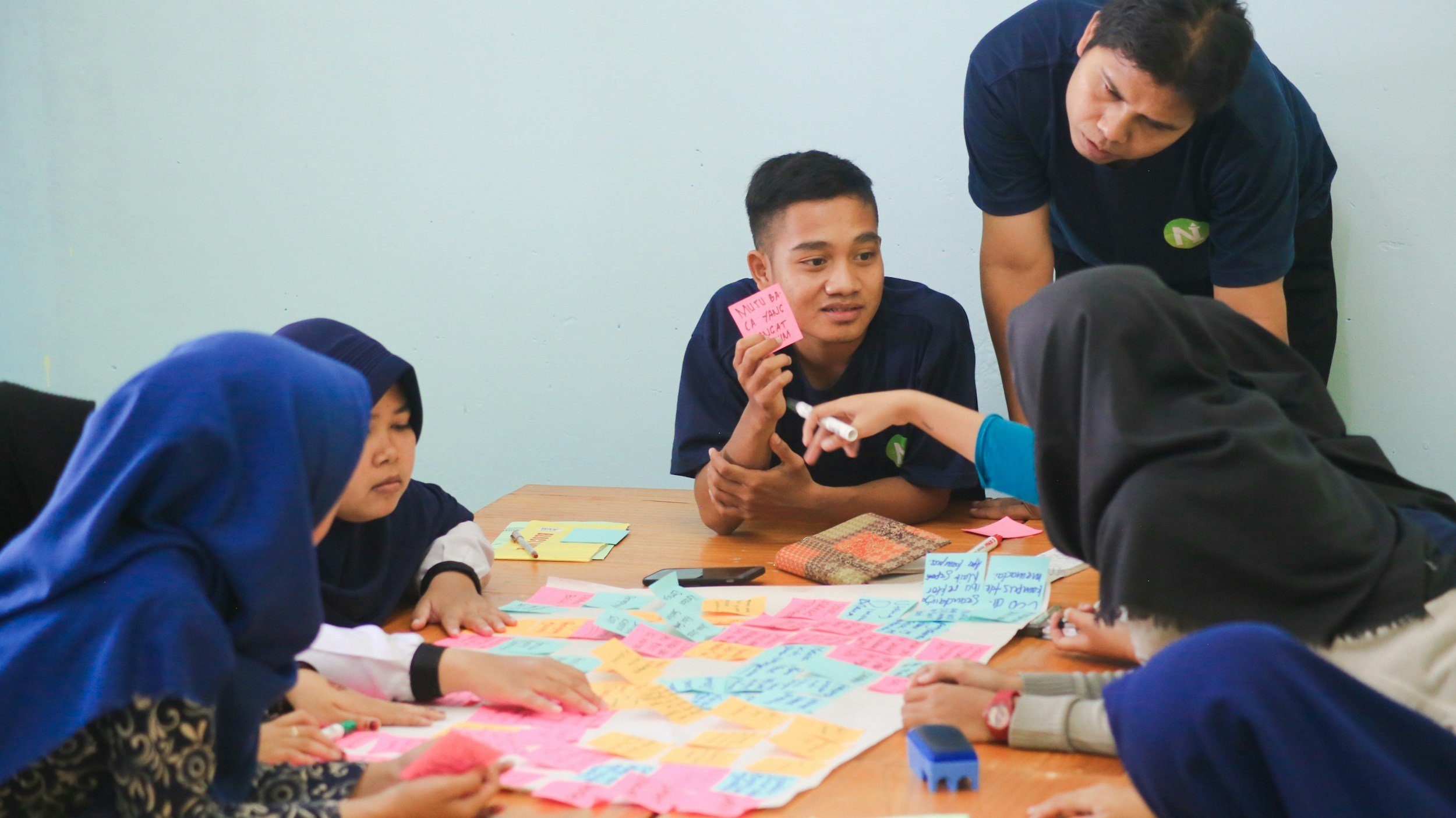
This is where design thinking comes in. Developed by the Stanford d.school, it is a human-centered approach to problem-solving that begins with understanding real needs, then moves through ideation, testing, and refinement. It forces you to slow down, pay attention, and build something in response to what you actually see instead of jumping straight to a polished idea.
Here is how that process actually works.
1. Start by Paying Attention
If you take one thing from design thinking, it is this: you cannot solve what you have not learned to see clearly. You have to get in the habit of questioning what you normally accept.
Most students stay at the surface level. They participate, complete the activity, log the hours, and move on.
That starts with empathy, not as a vague feeling, but as a practical way of understanding how people actually experience their environment. One of the simplest tools from the Stanford d.school is an observation log. Use your phone notes. Write down what you actually see in your day: school programs that exist but don’t feel meaningful, spaces that are available but unused, opportunities that exist but do not reach the people they are meant for.
The best way to obtain new perspectives is to have conversations. Talk to people outside your usual circle. Ask neighbors what has changed in the area. Sit in a coffee shop and listen to what people are discussing in real time. Read your local newspaper, not just headlines, but the small stories about what is happening in your community. Stanford’s “Needfinding” crib sheet is a great starting place for meaningful questions to ask people you encounter.
And reconsider what seems “normal” in your day to day life. For example, many high school students volunteer during the school year with younger kids. They show up consistently, help out, build relationships. Then summer arrives and the programs stop. The support disappears. The kids are still there, but the structure is not. Most students just take this as a given. But if you’re following the design thinking mindset, the next step is asking “Why?” and “What if…?”
Or take environmental initiatives like recycling or composting. Sure, everyone in the neighborhood might have a bin, but you notice only a handful of houses put it out each week. If you dig deeper, you might find that pickup schedules are unclear, rules vary by location, and people are unsure what goes where. A simple color-coded calendar for pickup days could shift behavior more than another awareness campaign. Once again, asking '“Why” and “What if…” can open up novel possibilities for change.
2. Start Where You Are and Dig Deeper
If you are already involved in something, don’t just assume you have to stick with the status quo.. Treat every experience, big and small, as something you can still learn from and dig deeper into.
Let’s say you volunteer with an organization that supports athletes with disabilities. Most students only focus on the experience itself and not the structure and effort behind it. Once again, start questioning what you are seeing. Why does the program exist in its current form? What needs are still not being met? Are athletes actually getting equal access to equipment, training environments, or opportunities to compete? If not, what is creating that gap?
Or take a major social issue like food insecurity. It’s easy to notice hunger issues in your community and say you want to help, but much harder to understand why the problem persists even when food banks and hunger vans exist. In many communities, food insecurity is shaped by transportation, inconsistent access to fresh food, and lack of awareness about existing support systems. Deeper investigation into the “why” behind food insecurity has led to innovations like community fridges, which create consistent access points for food while also making the issue publicly visible in a way that traditional systems like food drives often don’t.
At this stage, the goal is to stay in the observation and empathy phase of design thinking. Document what you see, talk to the people involved, and resist jumping to solutions before you understand the pattern clearly. What you assume the problem is and what the problem actually is are often not the same thing.
3. Find the Friction and Follow It
Friction isn’t just something you learn about in a physics class. In real life, it’s anything that feels a little rough around the edges, where something should work more smoothly but doesn’t.
Many major tech ideas actually came from that same instinct to remove small, everyday friction. Uber grew out of the frustration of not being able to reliably hail a cab in a busy city. DoorDash tackled the problem of restaurants and customers needing a more dependable way to connect with delivery drivers. Even Airbnb started from something simple: it was hard to find affordable places to stay in a city during big events.
But friction doesn’t have to be global or tech-scale to matter. The same way of thinking applies to small, local problems too, especially the ones you see every day in your own school or community.
Once you start paying attention, you’ll notice it everywhere. A program that exists to increase access, but only reaches the same group of students every time. An opportunity that is announced once, then quietly disappears unless you already knew to look for it. A club or resource that is technically open to anyone, but in practice actually depends on who hears about it first or who has the right connection.
Or perhaps you’re in a suburban area with a great array internships and summer programs, but notice that only students with transportation or certain networks can realistically access them. It’s time to start asking questions about how opportunity is actually distributed in your school, even if no one says it out loud.
Maybe you notice students around you relying heavily on AI to get through writing assignments and slowly losing confidence in their own voice. The next step is to conduct research and perhaps interview key teachers to understand the widening gap between what high school writing is supposed to develop and what students are actually doing to get through.
Your job here is not to label any particular trend as good or bad right away. Focus instead on investigating and analyzing the problem enough to understand what is driving it. You want to get deeply involved and invested enough to know who is most affected, what makes the problem continue, and why it has not been addressed in a meaningful way.
What’s Next
If you take this process seriously, you’ll end up with something far more important than another generic resume line item: a real problem worth digging into. The goal right now is not to solve anything. It’s to find something that feels worth your attention and start understanding it more deeply. A gap, a pattern, a moment of friction in your own community that you cannot ignore once you see it. You don’t need to know what the solution is yet. That comes later. Right now, you’re just learning how to recognize what deserves to be worked on.
If you’re wondering “But how can I translate this issue into something actionable?,” stay tuned for Part 2 of this series (coming in May 2026). In the next blog, we’ll take that starting point you’ve discovered and turn it into something more structured. You’ll learn how to define the scope of your project and build something that actually fits the reality of your community.
But for now, give this stage of the process your best effort. Commit to talking to new people, getting outside of your comfort zone, and doing your research. As the Stanford d.school puts it, “Empathy is the starting point for human-centered design.” That starts with noticing what others overlook and then analyzing what you see long enough to understand what is actually going on.
So don’t just wait around hoping for opportunities to show up. Be brave, and go out and pay attention to what is already in front of you.